Friday, 6 June 2014

What is the Suffrage Movement


THE SUFFRAGE MOVEMENT

The Suffrage Movement in Britain was between 1850 and 1920 and the plight for woman's right to vote was first highlighted as early as 1792 when Mary Wollstonecraft published 'Vindication of the Rights of Women'.

Millicent Fawcett (1847-1929)
The main argument to support the Suffrage movement was the right to vote for women. Although the right to vote for women was not granted until as late as 1918, it did not stop a tireless campaign by Suffragettes and Suffragists to secure their right to vote, along with other issues such as the right to education and the right to keep property and assets once married.
The Suffrage movement faced opposition from almost every angle, the most defiant opposition was in fact from a female, namely Queen Victoria, who in 1870 stated "Let women be what God intended, a helpmate for men, but with totally different duties and vocations".
The Suffragists, belonged to the National Union of Women's Suffrage Societies(NUWSS). This society was founded in 1897 by Millicent Fawcett (1847-1929). The Suffragists encouraged and believed in campaigning peacefully by means of petitions, public meetings, posters and lobbying.

Emmeline Pankhurst (1858-1928)
The Suffragettes belonged to the Women's Social and Political Union (WSPU). The WSPU was formed in 1903 by leading activist Emmeline Pankhurst (1858-1928). The WSPU's formation was born out frustration at the lack of progress made by The NUWSS.
Although united in the same cause, the Suffragettes (NUWSS) and Suffragists (WSPU) were somewhat divided in their campaign style and tactics.
The Suffragettes were not adverse to using somewhat guerrilla tactics to raise awareness to their campaign, some of these tactics included chaining themselves to the railings of Government buildings and carrying out criminal acts of vandalism such as smashing windows, which led to prison sentences being handed out, paving a clear path for a more peaceful campaign by the Suffragists.
The first world war proved instrumental to the whole Suffrage movement. The declaration of war against Germany in 1914 had a large percentage of the male population being sent off to war. This created a void in the work force, requiring women to fill the roles of their male counterparts.
With a dramatic decrease in the campaigning by both the NUWSS and the WSPU, Millicent Fawcett took the initiative to form an alliance with leading political figures and secure support for the Suffrage cause. This led to an act being passed in Parliament in 1918 which allowed women over 30,who met certain property qualifications, to have the right to vote. The act was amended in 1928 and allowed all women over the age of 21 to the right to vote.




Thursday, 5 June 2014

WSPU vs NUWSS

WSPU vs NUWSS
The right to vote was an idea supported by both the WSPU and the NUWSS, however the tactics used to ensure the voices were heard were very different indeed.
The Suffrage movement, although primarily concerned with the right to vote, it also concerned itself with issues such as education and marriage. 
Initially just one group, the suffrage movement consisted of numerous members under the title of the NUWSS, however after much frustration at how the movement was heading, One lady by the name of  Emily Pankhurst founded the sister group to the NUWSS, this group was known as WSPU (BBC, 2014)
The WSPU were now known as Suffragettes and The NUWSS being referred to as Suffragists.
The key aim of the WSPU was the draw attention to the issue of women’s suffrage and the organisation developed into a formidable propaganda machine. It successful raised funds and this allowed the purchase of property in London and the provinces. In London, the WSPU established its headquarters at Clement’s Inn and in May 1910, opened a shop in Charing Cross Road – the Women’s Press. As well as earning money for the WSPU, the shop publicised the cause. Suffragette activities were organised and coordinated from Clement’s Inn and later Lincoln’s Inn. These ranged from the huge demonstrations and other major ventures as well as the less important but equally significant everyday activities of the campaign. The less prestigious activities included: organising meetings and rallies; producing a circulating leaflets and tickets for indoor meetings; organising suffragettes to chalk pavements to advertise meetings; and, design and market goods to be sold in the suffragette shops. The suffragette newspaper Votes for Women was written and produced at Clement’s Inn and sold by volunteers (often dressed in suffragette colours) and via ‘press carts’ (horse-drawn waggons decorated with WSPU propaganda) as well as in newsagents. (Moore, 2008).


For three years the WSPU did valuable propaganda work in the cotton towns of the North of England. Their plans soon turned into direct action which consisted of politicians being questioned and interrupted, and MPs challenged and ridiculed during by-election campaigns. ‘Deeds not words’ was the WSPU’s slogan and a new style for the 20th century struggle. (Kidd & Rees, 2003)
Despite the differences in policy and style, the two organisations (the WSPU and the NUWSS) worked well together, at least in the early years! Mrs. Fawcett, President of the NUWSS, even praised the bold tactics and courage of the WSPU.
Arrest and imprisonment were tactics used by the WSPU. When their requests were turned down they would make protest speeches and be arrested. These women would choose to go to prison rather than pay fines. These tactics gave the WSPU valuable publicity and new recruits joined the movement.

By the autumn of 1907 there were changes in the WSPU. By force of personality and the support of her mother Christabel gained control of the WSPU in London. Mrs. Pankhurst and her daughter Christabel however were strongly criticised by three senior members of the organisation about their style of leadership. Some of their critics  founded a new party, the Women’s Freedom League (WFL).

 The WFL was also a militant organisation which attacked the government, however they criticised the WSPU’s campaign of vandalism against private and commercial property. Over 100 of their members were sent to prison for various offences committed while protesting against the government’s inaction on votes for women. (Moore, 2008)

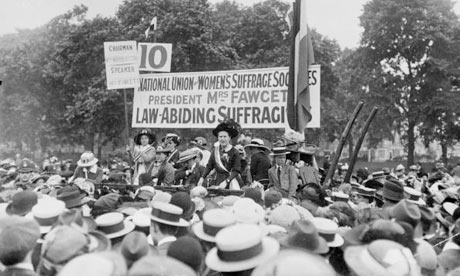
 In 1897, various local women's suffrage societies formed the National Union of Women's Suffrage Societies, under the leadership of Millicent Fawcett. The NUWSS wanted the vote for middle class property-owning women. They believed they would achieve their end using peaceful tactics - non-violent demonstrations, petitions and the lobbying of MPs. Fawcett believed that if the organisation was seen to be intelligent, polite and law-abiding then women would prove themselves responsible enough to participate fully in politics. (BBC, 2014)


 Millicent Fawcett at the rally in Hyde Park
Millicent Fawcett addressing one of her many rallies


NATIONAL UNION OF WOMEN'S SUFFRAGE SOCIETIES (NUWSS)

NATIONAL UNION OF WOMEN'S SUFFRAGE SOCIETIES (NUWSS)
1897 saw the formation of the National Union of Women's Suffrage Societies (NUWSS). It brought together seventeen societies that actively represented every suffrage society in Britain (Parliament.UK, 2014).
The societies that came together have been published in the following image which can be found at the following website: http://www.parliament.uk/about/living-heritage
The founder of the NUWSS was a lady by the name of Millicent Fawcett.

In 1897, various local women's suffrage societies formed the National Union of Women's Suffrage Societies, under the leadership of Millicent Fawcett. The NUWSS wanted the vote for middle class property-owning women. They believed they would achieve their end using peaceful tactics - non-violent demonstrations, petitions and the lobbying of MPs. Fawcett believed that if the organisation was seen to be intelligent, polite and law-abiding then women would prove themselves responsible enough to participate fully in politics.

The leadership of the suffragists was exclusively middle class but some of the more radical members recognised early on that the movement needed the support of working class women. The issue of the franchise was drawing women of various sections of society together and giving them an identity which they had lacked until that time (BBC, 2014).


Millicent Fawcett

Millicent Fawcett was born in 1847 and married the Liberal MP Henry Fawcett in 1867. She began a writing and speaking career - discussing women's education and women's suffrage among other issues. After the death of Lydia Becker, Fawcett emerged as the suffrage movement's leader and presided over a committee that eventually became the National Union of Women's Suffrage Societies (NUWSS) in 1897. Fawcett found support amongst university women as well as many working class women who preferred the NUWSS's peaceful, legal campaigning methods.
Fawcett recognised the positive effect of the First World War on the suffrage campaign and encouraged campaigners to accept the compromise of women over 30 being enfranchised. She resigned as president of the NUWSS in 1919 but was still heavily involved with the organisation, rechristened as the National Union of Societies for Equal Citizenship (NUSEC). She campaigned for the legal profession to be opened to women, for example. She died in 1929. http://www.bl.uk/learning/histcitizen


The NUWSS chose to wear the colours Red, White and Green. The colours were a symbol unity and to show support towards the suffrage movement.


Below is an image of a badge which would have been worn by members of the NUWSS to show their support


http://www.parliament.uk/about/living-heritage/transformingsociety/electionsvoting/womenvote/parliamentary-collections/collections-19thc-and-suffragists/nuwss-badge/


Black Friday

Black Friday

Black Friday took place on Friday November 18th 1910.


Approximately 300 women descended upon the House of Commons in protest. The women were denied any entry to the House of Commons and violence soon ensued. The Police were ruthless in their tactics and showed large levels of violence and sexual assault towards the suffragettes (Smith, 2010).

The whole protest behind Black Friday came about after the failure of the 1910 Conciliation Bill. The bill would extend the right of women in the Britain and Ireland to vote to number somewhere in the region of 1,000,000 (Connor, 2010).

http://www.hastingspress.co.uk/history/sufpix.htm


World War One and the Changing Attitude to Women

World War One and the Changing Attitude to Women

World war one broke out across Europe in 1914 and both the Suffragists and the Suffragettes suspended their campaign to the right to vote. 

The Suffragists worked hard to get young men to join the army and a large demonstration was held demanding that women be allowed to work in the munitions factory (BBC, 2014).

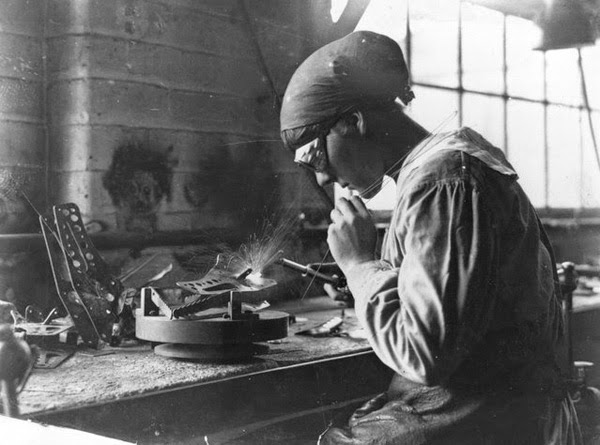
Women gained access to a wide range of vocations including bus conducting, postal workers and coal delivery. Many women surprised their male counterparts by succeeding in heavy manual work as well as skilled, dexterous work such as engineering (BBC, 2014).

Iconic image of 'Rosie the Riveter'
http://www.visualnews.com/2013/09/03/working-women-first-world-war/

Women working in a munitions factory during WW1
http://www.visualnews.com/2013/09/03/working-women-first-world-war/

Traditional family structure was completely changed by the First World War.
Many married women were forced into the workplace by the death of their husbands.
Other women were drafted into industries that had been depleted by military conscription.
Over the course of the war:
  • 200,000 women took up jobs in governmental departments.
  • 500,000 took up clerical positions in private offices.
  • 250,000 worked on in agricultural positions.
  • 700,000 women took up posts in the munitions industry, which was dangerous work.
  • Many more women did hard heavy work, including ship building and furnace stoking. These types of jobs had excluded women prior to the war.
In July 1914, before the war broke out there were 3.2 million women in employment. This had risen to 5 million by January 1918.(BBC, 2014)
The war meant women had to take on a number of traditionally male roles. Their ability to do this led to a change in attitudes.
World War 1 caused the British suffrage movement to split:
  • Emmeline Pankhurst (leader of the Women’s Social and Political Union) called for a temporary ceasefire in their campaign so the country could focus fully on the war effort.
  • Sylvia Pankhurst and her Women’s Suffrage Federation were more radical and wanted the struggle to continue in spite of the situation.
When the war ended in November 1918 8.4 million women were granted the right to vote.
The Eligibility of Women Act was also passed in November 1918. This meant that some women could now be elected as members of Parliament.
World War 1 was undoubtedly the final catalyst for women to be given the vote. However, women would have to wait until 1928 to be granted the vote on equal terms with British men. This was brought by the Representation of the People Act, which stated all women over the age of 21 could vote (BBC, 2014)
There is no doubt that the war played an influential part in women gaining the right to vote but it was not the only key factor. Tireless campaigning by both parties of the suffrage movement, the NUWSS and WSPU played key roles in securing the right to vote, however that said, the women's effort in the war begs the question 'How could a country happily accept the help of its female population and yet still deny them the right to participate in its decision making process?'.